Clinician-built
The app was designed and coded by speech-language pathologists and assistive technology specialists—not simply reviewed after development.
Research and clinical foundation
InnerVoice combines speech-language pathology, assistive technology, communication science, and more than a decade of product development. The result is an AAC system built around communicator agency and the realities of daily implementation.
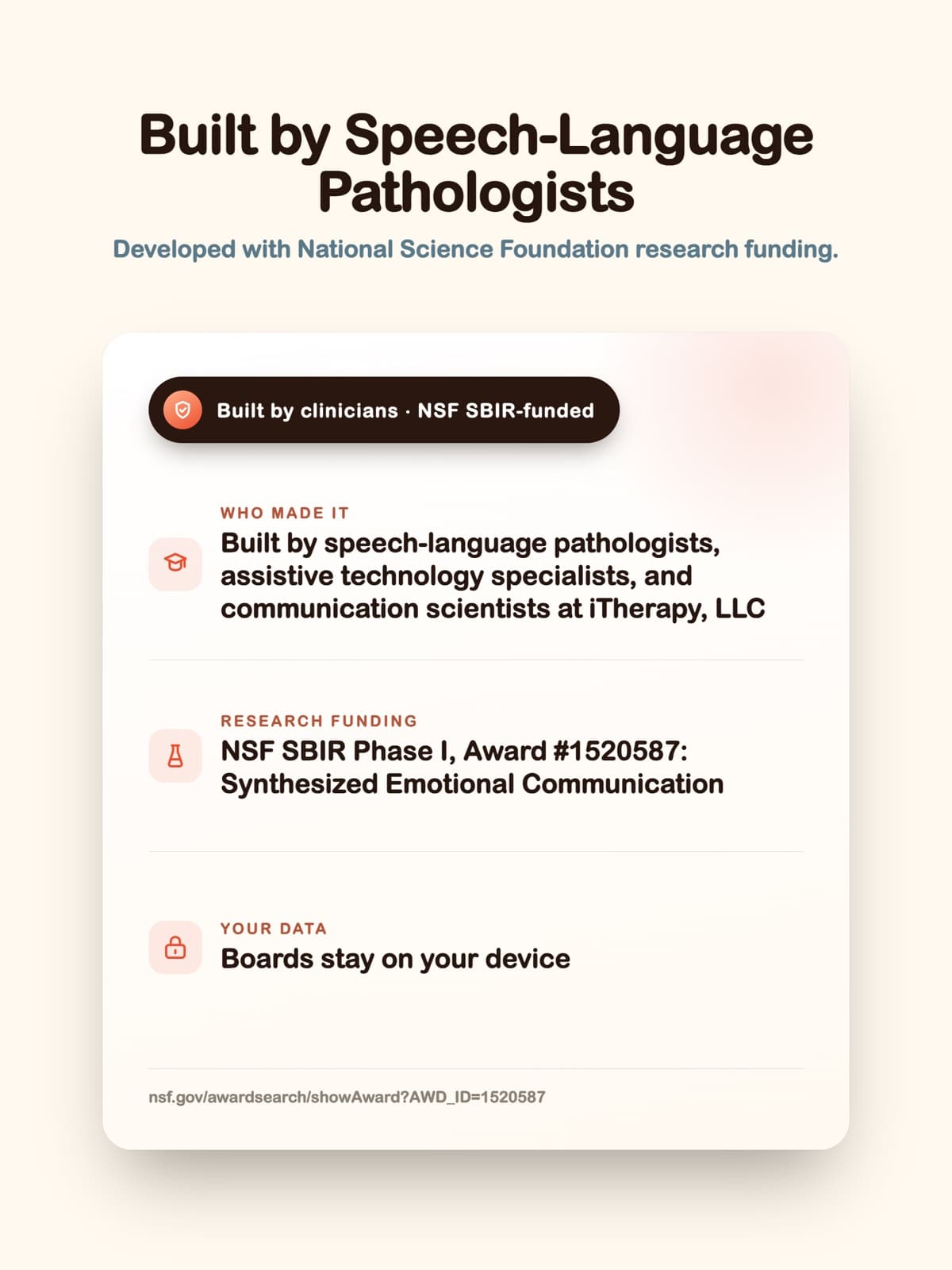
The app was designed and coded by speech-language pathologists and assistive technology specialists—not simply reviewed after development.
The expressive avatar system grew from National Science Foundation-funded work on synthesized emotional communication.
InnerVoice supports communication. It does not replace the communicator, and it is not a medical device. Clinicians remain responsible for goals and interpretation.
AAC partner instruction
InnerVoice's partner guidance is aligned with studied AAC strategies: aided modeling, expectant delay, open-ended questions, and responsive interaction. These studies support the strategies—not a claim that they clinically validated InnerVoice.
Meta-analysis
A 2015 meta-analysis of 17 single-case studies involving 53 AAC users found communication-partner interventions highly effective across participant groups and outcomes. Frequently trained skills included aided modeling, expectant delay, and open-ended questions.
Read the PubMed recordNatural environments
In a two-year study of 71 preschoolers with developmental disabilities, augmented input from peers was associated with stronger language growth. Teacher prompting and question asking were associated with weaker growth, underscoring the difference between responsive interaction and repeated testing.
Read the PubMed recordSchool implementation
A 2024 four-school multiple-case study found that teachers increased access to communication boards, augmented input, and responsive strategies after partner intervention. Follow-up varied, showing why support must remain available in the daily environment.
Read the PubMed recordWhat the research shaped
InnerVoice 7 uses Matthew Guggemos's V4 avatar system exclusively. It combines seven carefully drawn expressions with anime-inspired speech animation so facial expression, spoken language, written language, and button-to-speech AAC can be seen together on a face the communicator chose. V4 does not use gaze tracking.
NSF SBIR Phase I Award #1520587 supported research into synthesized emotional communication. That provenance is specific: it supports the origin of the expression system, not a broad claim that the app guarantees a clinical outcome.
View the NSF award recordThe product principle
That principle is why messages can grow into complete thoughts, why every “no” is honored, and why Teacher Modeling pauses goal tracking instead of attributing an adult's language to the student.
See the InnerVoice + EASI workflowSee how InnerVoice works